

Best explainable AI tools for tracing LLM decisions in 2026
When teams inspect only an LLM's final response, retrieval failures, incorrect tool calls, and flawed intermediate decisions remain hidden. Without execution-level context, they may fix the visible symptom while missing its cause.
LLM applications and agents need more than a prediction score. They need a trace of the execution path paired with evaluations of output quality, because that combination is what reveals which step in a multi-step run failed and why.
This guide leads with the tools that explain LLM applications and agents, then covers classical feature attribution for tabular and vision models. Braintrust is the strongest option for LLM applications and agents because traces, scorers, datasets, and experiments work together in one evaluation workflow, answering not just what an LLM decided but why. Trace and evaluate your LLM application for free with Braintrust.
Why explainability changes from models to LLM applications
The explanation a team needs depends on whether it is examining the behavior of a complete AI application or an individual model prediction.
Application-level explainability: An LLM agent's output depends on retrieved context, tool selection, memory, and several intermediate steps, and a wrong output can originate at any one of them. A trace captures this execution path, while evaluations score each step so a team can find which one produced an incorrect or low-quality result. Arize Phoenix and Braintrust support application-level, trace-based explanation, and Braintrust ties those scores directly into datasets and regression experiments.
Model-level explainability: For tabular and vision models, feature attribution estimates how each input influenced a prediction. SHAP and LIME provide model-agnostic methods, while Fiddler AI and Captum add managed and PyTorch-specific options.
Application-level explainability overlaps with LLM observability because both rely on traces. Explainability investigates a specific output, while observability tracks behavior across production traffic.
Also read: What is LLM observability? (Tracing, evals, and monitoring explained) and AI observability tools: A buyer's guide.
Why token-level attribution falls short for LLM applications
Token attribution measures input influence within one model call, while a trace connects the application steps that shaped the response.
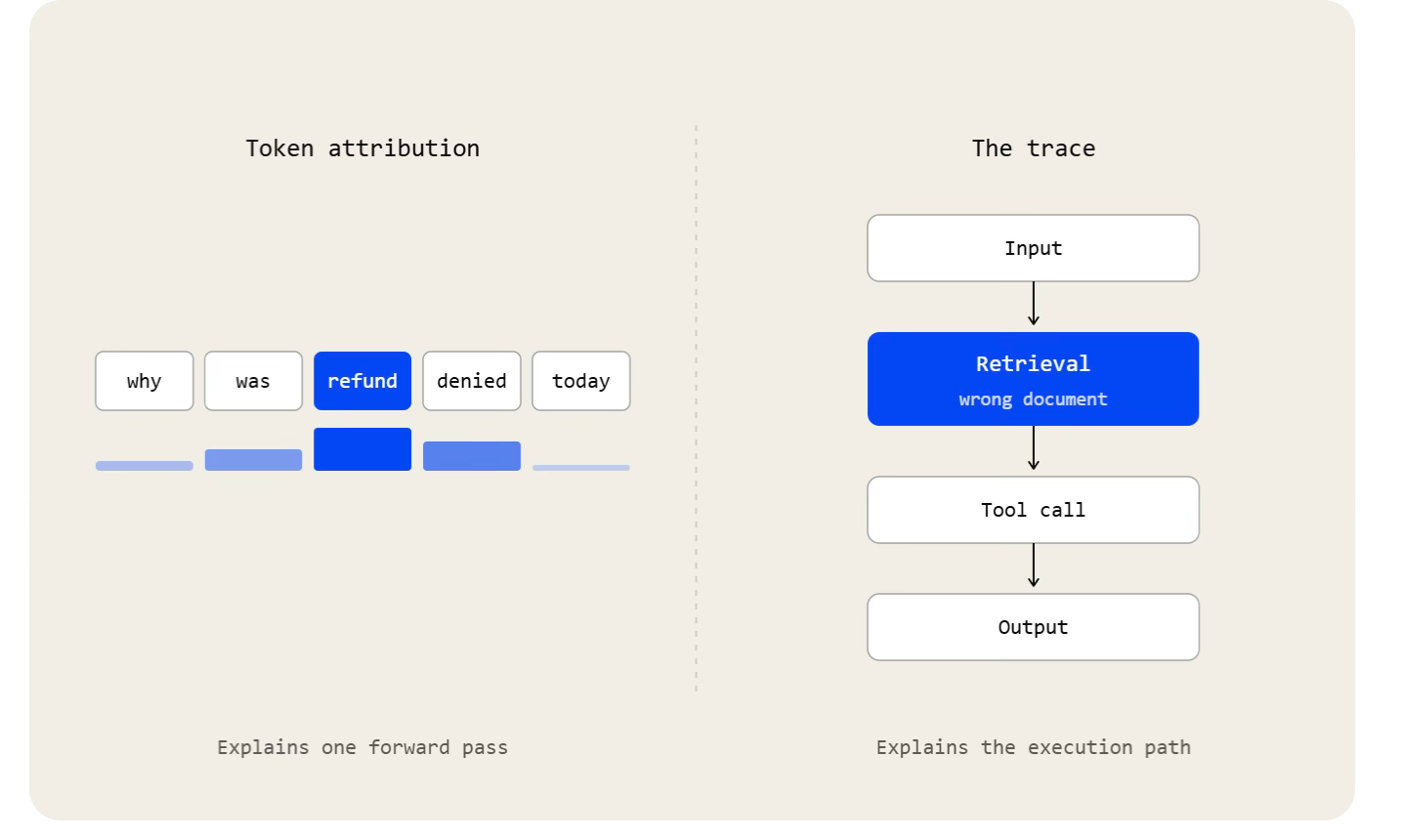
Token attribution is useful for investigating how prompt text influenced one output, but an LLM application's response often depends on decisions made outside the final model call.
An agent may retrieve the wrong policy before generation and carry that error through its plan. The same failure can surface later as an incorrect tool argument or an unsupported answer. A token map of the final response will not identify the earlier step, which is why teams also need tracing across tool calls and memory.
By recording the sequence from retrieval through tool use and generation, a trace gives teams the context to evaluate individual spans and identify the step that introduced the error.
Best explainable AI tools for LLM applications
For anyone building with LLMs, trace-level visibility plus evals is the explainability layer. The trace shows each step the system took, and the evals score how well those steps performed, so together they answer why an output turned out the way it did.
1. Braintrust
Braintrust is the strongest choice for explaining LLM applications because it does not stop at showing what happened. It scores what happened, and it turns that score into the next fix.
Once an application is instrumented through the Braintrust SDK or OpenTelemetry, each request appears as a trace composed of nested spans. The span tree connects the final output to the model calls, retrieval steps, and tool invocations that preceded it, so a team can see exactly which step an agent took before it produced a bad answer. Braintrust's guide to reading a trace walks through the inputs, outputs, timing, and scores recorded at each step.
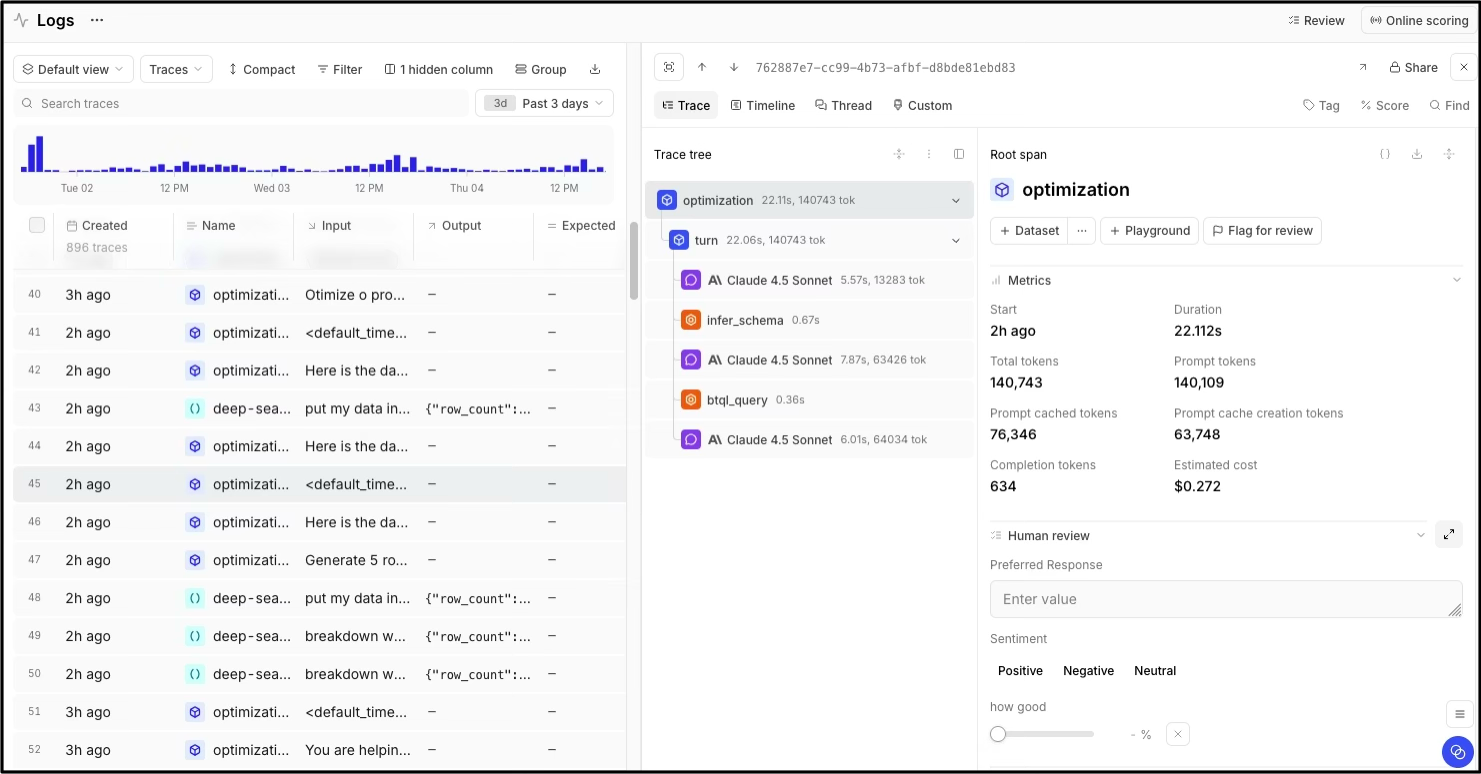
Strengths: Custom scorers and LLM-as-a-judge evaluations measure factual accuracy, helpfulness, format compliance, or criteria a team defines itself, and that is what separates Braintrust from a tracing tool that only shows the path. Scorers run on experiment test cases before a release and continuously on production traces after it, so the same evaluation logic explains a failure in staging and a failure in the wild. A low-scoring example does not just get flagged, it gets added to a dataset and rerun as a regression test, closing the loop from explanation to fix.
Scope: Braintrust explains application behavior through the execution path and its quality scores. Classical feature attribution still requires a tool such as SHAP, LIME, or Captum, but for any team building with LLMs or agents, that is the smaller problem to solve.
Pricing: The Starter plan includes 1 GB of processed data, 10,000 scores, and 14-day retention each month. Users, projects, datasets, playgrounds, and experiments are unlimited.
Best for: Braintrust is the best explainability tool for LLM application and agent teams. Phoenix and other tracing tools show the path, but Braintrust is the only one here that turns that path into a scored, reusable feedback loop across evaluation, production monitoring, and regression testing.
Trace and evaluate your LLM application with Braintrust.
2. Arize Phoenix
Arize Phoenix is the open-source alternative to Braintrust for trace-based LLM evaluation. Built on OpenTelemetry and OpenInference, Phoenix captures model calls, retrieval, tool use, and custom application logic through automatic or manual instrumentation.
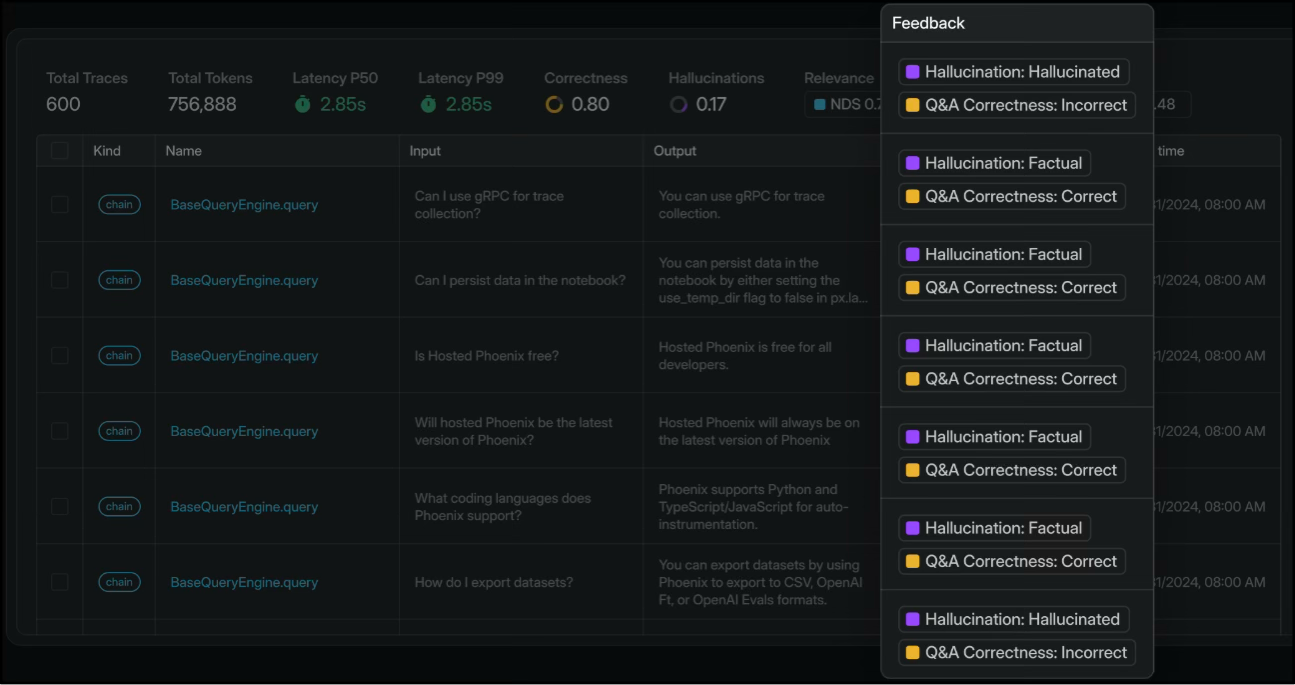
Strengths: Phoenix accepts OTLP traces and supports numerous frameworks, model providers, and programming languages. Its evaluation workflow includes prebuilt and custom evaluators, human annotation, datasets, and experiments.
Limitations: Teams that self-host Phoenix must operate the service and manage its data retention themselves, and Phoenix's evaluation layer does not carry the same scores into a shared dataset and regression workflow that Braintrust does. Phoenix Cloud provides a managed deployment option.
Best for: Teams that want open-source tracing and evaluations and that are willing to operate the service themselves.
Best explainable AI tools for classical ML models
For structured and vision models, feature attribution remains the main method for explaining individual predictions. The options below range from open-source Python libraries to managed monitoring and governance.
3. SHAP and LIME
SHAP and LIME are open-source Python libraries for explaining model predictions. SHAP uses Shapley values to calculate each feature's contribution and can summarize those contributions across a dataset. LIME perturbs the inputs around one prediction and fits an interpretable local surrogate to estimate which features had the greatest influence.
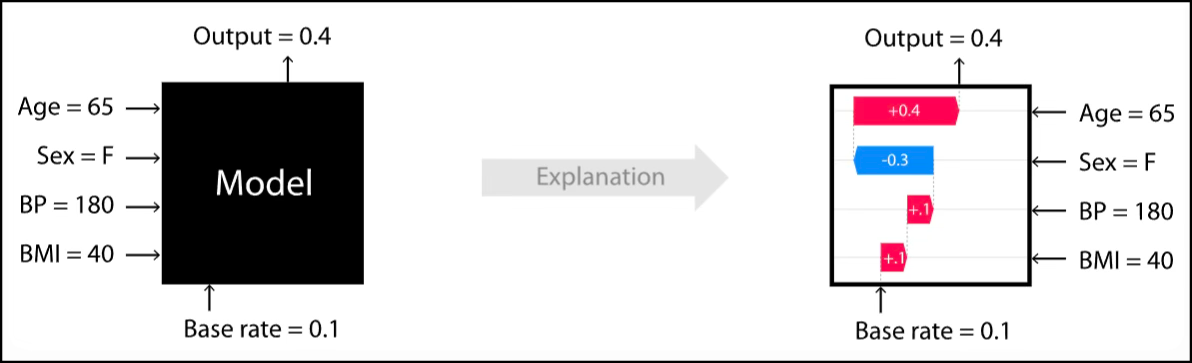
Strengths: Both provide model-agnostic interfaces and support tabular, text, and image data. SHAP also includes optimized explainers for specific model families.
Limitations: SHAP can require substantial compute depending on the model, explainer, and background dataset. LIME results depend on its sampling process and may change when the random seed or local neighborhood changes.
Best for: Teams that want open-source feature attribution without adopting a managed explainability product.
4. Fiddler AI
For production governance, Fiddler AI combines standard SHAP, an optimized Fiddler SHAP implementation, Integrated Gradients, permutation importance, and proprietary attribution methods. Explanations sit within a broader AI observability product that monitors model performance, drift, fairness, and bias.
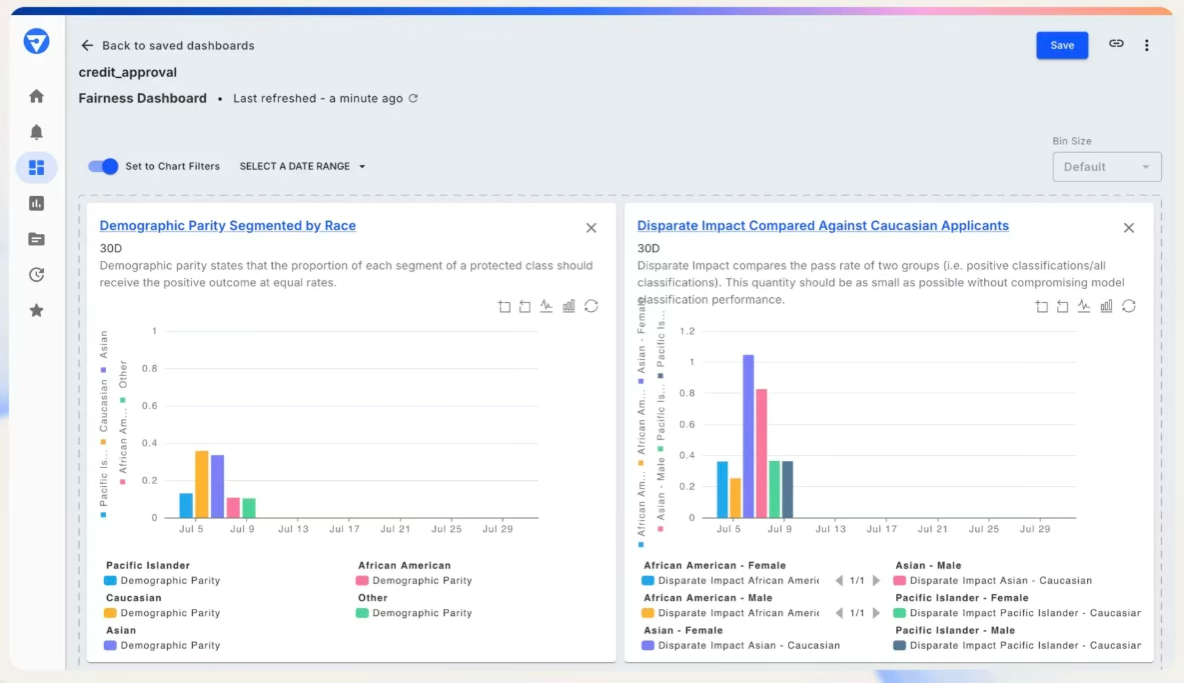
Strengths: Feature attribution can be reviewed alongside production monitoring and fairness analysis, giving model owners and risk teams a shared view of model behavior.
Limitations: Fiddler requires model onboarding and product configuration. Its broader monitoring and governance scope may exceed the needs of teams seeking only local feature explanations.
Best for: Enterprises that need model explanations alongside monitoring, fairness analysis, and governance controls.
5. Captum
PyTorch teams can use Captum to apply attribution methods directly in code. The open-source Meta library includes Integrated Gradients, saliency, feature ablation, layer attribution, neuron attribution, and concept-based methods such as TCAV. Captum Insights adds an interactive interface for comparing model predictions with attribution results.
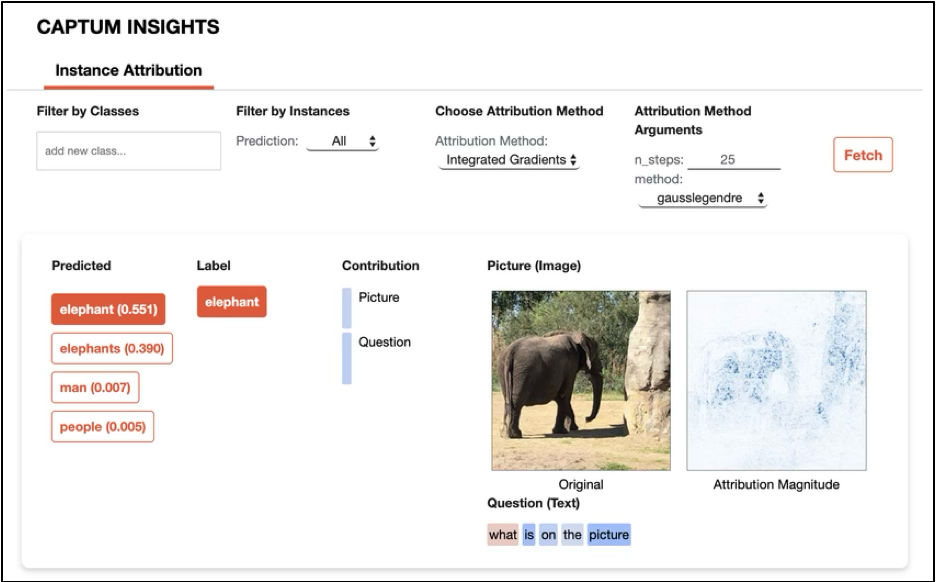
Strengths: Gradient-based methods can inspect PyTorch model internals, while the broader algorithm catalog supports analyzing features, layers, neurons, and learned concepts.
Limitations: Captum remains code-first and does not provide managed monitoring, shared result storage, or production collaboration workflows.
Best for: Researchers and ML engineers who need direct access to PyTorch model internals and multiple attribution methods.
Explainable AI tools comparison
Start with the evidence your team needs to inspect, because feature contributions and application traces lead to different tool choices.
| Tool | What it explains | Model type | Open source or hosted | Setup effort |
|---|---|---|---|---|
| Braintrust | Execution traces linked to experiment and production scores | LLM applications and agents | Managed cloud; Enterprise on-premises option | SDK or OpenTelemetry instrumentation |
| Arize Phoenix | Execution traces with evaluation results | LLM applications and agents | Open source; local, self-hosted, or Phoenix Cloud | OTLP or framework instrumentation |
| SHAP + LIME | How input features influence individual predictions | Tabular, text, and vision models | Open source | Python integration; SHAP compute varies by model and explainer |
| Fiddler AI | Prediction drivers and production model or agent behavior | Predictive models and LLM applications | Commercial; SaaS, VPC, on-premises, or air-gapped | Model or application onboarding plus monitoring configuration |
| Captum | Attribution for features, layers, neurons, and concepts | PyTorch models, especially vision and NLP | Open source | Code integration with access to model internals |
How to choose the right explainable AI tool
Use the criteria below to narrow the shortlist for the system your team needs to explain.
Tabular, text, or vision models: SHAP and LIME provide open-source local explanations that teams can run in Python. Fiddler adds centralized monitoring, fairness analysis, and enterprise deployment options for production governance.
PyTorch models: Captum works directly with PyTorch models and supports attribution across features, layers, neurons, and learned concepts.
LLM applications or agents: Phoenix provides open-source tracing with local, self-hosted, and cloud deployment options. Braintrust is the stronger choice when evaluation needs to run continuously in production, since low-scoring traces flow directly into datasets and regression experiments.
Start free with Braintrust to trace and evaluate your LLM application.
FAQs: Best explainable AI tools (2026)
Is explainable AI the same as interpretable AI?
Although the terms overlap, interpretability usually describes a model whose behavior can be understood directly from its structure, such as a small decision tree. Explainability covers methods that help people understand the output of a model or larger AI system. The distinction is not standardized, so the terms are often used interchangeably.
Can you use SHAP on an LLM?
SHAP can be applied to a defined LLM function once the input representation, output target, and masking or background distribution are specified. The resulting values apply only to that configured function; causal interpretation and application-wide diagnosis require separate evidence.
What is the difference between explainability and observability?
Scope and cadence separate them. Observability runs continuously and covers reliability, latency, cost, and aggregate quality across production traffic, while explainability starts from one output and works backward through the evidence behind it. A trace can feed both.
Do GDPR and the EU AI Act require explainability for LLM systems?
Neither law requires a specific explainability method simply because a system uses an LLM. Under the GDPR, meaningful information about the logic, significance, and consequences must be provided in specified automated-decision contexts. The EU AI Act includes documentation, logging, and transparency requirements for high-risk systems.
Which explainable AI tools work for AI agents?
Agent runs are longer and less predictable than single model calls, so the requirement is span-level scoring on multi-step traces. Arize Phoenix and Braintrust both provide it. Phoenix delivers span-level evaluation through open-source OpenTelemetry instrumentation, while Braintrust ties those scores into review queues and regression experiments for production teams.